Planning an off-grid RV adventure requires reliable solar power to run essentials without relying on hookups. This guide highlights five top solar kit options suitable for RVs, campers, and other mobile applications. Each product combines panels with smart controllers and sturdy construction to endure road conditions. Read on for practical features, performance considerations, and a buying guide to match your energy needs on the road.
Summary of Selected Products
| Product | Brand | Type | Estimated Daily Output (Under Good Sun) | Controller Type | Notes |
|---|---|---|---|---|---|
| ECO-WORTHY 200W Solar Panel Kit | ECO-WORTHY | 200W Kit | 800Wh/day | 30A PWM | |
| Renogy 200W Adventurer Kit | Renogy | 200W Kit | ~800Wh/day | 30A PWM | |
| ECO-WORTHY 400W Premium Kit | ECO-WORTHY | 400W Kit | ~1.6kWh/day | MPPT Controller | |
| ECO-WORTHY 1.6KWH Complete RV System | ECO-WORTHY | 400W Kit + Batteries + Inverter | ~1.6kWh/day | 40A MPPT | |
| Renogy 200W Starter Kit | Renogy | 200W Kit | ~1,000Wh/day | 30A PWM |
ECO-WORTHY 200 Watts Solar Panel Kit

The ECO-WORTHY 200W kit targets RVs and other off-grid needs with a compact yet capable setup. It uses high-efficiency monocrystalline panels designed to maximize output under typical RV parking conditions. The 30A PWM charge controller provides straightforward battery management, protecting against overcharge and ensuring stable charging for lead-acid or lithium options. The kit’s aluminum frame is corrosion-resistant and built to withstand wind and snow loads, making it suitable for various climates. Installation is straightforward, and the system is scalable for mid-range RV power needs.
Key features indicate practical value for travelers: daily output guidance around 800Wh in four sun hours, a durable enclosure, and a weather-rated junction box. For RV owners starting with solar or upgrading from small portable setups, this kit offers a good balance of cost, performance, and reliability. The included components support simple expansion if you later choose to add more panels or a larger battery bank.
Renogy 200 Watts 12V Monocrystalline Kit
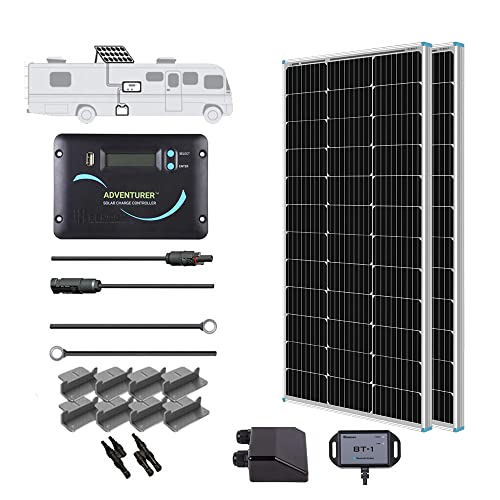
Renogy’s Adventurer kit is a compact, well-regarded option for RVs and boats requiring a small, reliable solar solution. The 200W of monocrystalline panels deliver robust efficiency, supported by a corrosion-resistant aluminum frame designed to withstand outdoor exposure. A 30A PWM charge controller integrates with various battery types, including sealed and flooded options, and provides essential protections against overcharge, overvoltage, discharge, and short circuits. The system’s efficiency and rugged construction make it a popular choice for RVers who want dependable power without excessive complexity.
Performance is driven by an expected daily output around 800–1000Wh under favorable sunlight. The system’s design emphasizes long-term durability, with heat-dissipating back sheets and reliable bypass diodes to handle partial shading. For travelers aiming to maintain basic appliances and recharge cycles while on the road, this kit offers a dependable, upgrade-friendly foundation that pairs well with existing battery banks.
ECO-WORTHY 400 Watt Premium Kit

This 400W premium kit is designed for higher energy demand RV setups. It pairs four 100W monocrystalline panels with a 40A MPPT controller, a Bluetooth module, and mounting brackets for flexible installation. The MPPT controller boosts efficiency by maximizing voltage and current adjustments, often delivering gains over PWM systems in partly shaded or cooler conditions. The kit emphasizes robust construction with IP-65 rated junction boxes and rugged aluminum framing to withstand wind and snow loads. The modular 100W panel design supports future expansion or reconfiguration on an RV roof.
With an estimated daily output around 1.6kWh under ideal sunlight, this kit suits larger RVs, campers with higher energy loads, or situations requiring faster battery charging. The kit’s performance claims, including MPPT efficiency advantages and a higher by-pass diode protection level, translate into more reliable charging during variable sun. For travelers who want a substantial energy buffer and room to scale, this is a strong choice.
ECO-WORTHY 7.168KWH Complete RV System

This all-in-one system targets heavier RV power needs with four 200W panels, a 3000W inverter charger, two 12.8V 280Ah lithium batteries, and a 60A MPPT controller. The setup supports multi-source energy input, including mains charging, which adds flexibility for remote trips with occasional land power access. The system claims the ability to run major AC appliances and sustain longer off-grid periods. Bluetooth integration and a robust tracking of energy flow help monitor performance and optimize charging strategies for higher-demand scenarios.
Users evaluating high-capacity energy solutions for full-timing, larger RVs, or off-grid adventures will find this kit appealing for its breadth and scale. The combination of lithium storage, a high-output inverter, and MPPT tracking provides a reliable backbone for more demanding loads, while the 4x200W panel array ensures a strong daily generation under optimal conditions. It is best suited for long trips with steady sun exposure and a need for substantial onboard energy storage.
Renogy 200W Starter Kit

Renogy’s 200W Starter Kit offers a well-rounded entry point for RV owners beginning their solar journey. With efficient 22% cell efficiency, these panels perform well in a range of lighting conditions. The kit includes a Wanderer PWM charge controller capable of supporting multiple battery chemistries, and its four-stage charging process helps ensure battery health and longevity. The build emphasizes quality encapsulation, heat management, and long service life, making it a sturdy base for future expansion as energy needs evolve.
In practical terms, this kit targets daily outputs near 1,000Wh under favorable sun. The sturdy, field-proven design supports easy repairs and enhancements, such as upgrading to a larger capacity MPPT controller or adding more panels in the future. For RV owners seeking reliability with an approachable price point and room for growth, this kit remains a dependable choice.
Buying Guide: Key Purchase Considerations
- Daily energy needs: Estimate rough daily usage in watt-hours (Wh). A typical mid-size RV may require 600–1500Wh per day for lights, a fridge, fans, and small electronics. Choose panels and storage that comfortably exceed this figure to cover cloudy days.
- Controller type: PWM controllers are cost-effective and simple but less efficient in variable sun. MPPT controllers offer higher efficiency, especially in cooler temperatures or when panels operate at higher voltages, but come at a higher cost. Consider future expansion and climate when selecting.
- Panel configuration and space: Roof space and mounting considerations influence how many panels you can install. Higher wattage per panel reduces needed space, but may require sturdier mounting and wiring.
- Battery chemistry: Lead-acid systems are budget-friendly but require more maintenance and have lower depth of discharge. Lithium iron phosphate (LiFePO4) batteries offer longer life, higher depth of discharge, and lighter weight, ideal for frequent RV use and long trips.
- Durability and weather resistance: Look for corrosion-resistant frames, IP-rated junction boxes, and panels designed to withstand wind and snow loads for reliability in diverse climates.
- Expandability: If you plan to upgrade later, choose modular kits that allow adding panels, controllers, or larger inverters without replacing existing components.
- Installation ease: Some kits are “plug-and-play” with pre-wired components and mounting hardware, while others require more customization. Assess your DIY comfort level and consider professional help if needed.
- System integration: Ensure compatibility between panels, controllers, and batteries. Cross-verify voltage and amperage ratings to prevent overcharging or damage to equipment.
- Maintenance: Consider monitoring features (Bluetooth, apps, or displays) that help track performance and alert you to issues like shading or degraded panels.
Performance considerations for RV use
RV solar setups perform best with clear, unobstructed sun exposure and a matched battery bank. In shaded or overcast conditions, even premium MPPT controllers will see reduced output. Regularly inspecting wiring, connectors, and mounting hardware helps maintain efficiency and safety on long trips. When choosing a kit, consider not only peak wattage but how much energy you can reliably harvest per day in your typical driving and camping scenarios.
Choosing between PWM and MPPT controllers often hinges on budget and future plans. If you expect to expand to a larger system or live off-grid for extended periods, MPPT controllers deliver meaningful efficiency gains that justify their cost. For simpler setups or tight budgets, PWM kits provide dependable performance with straightforward maintenance.
For travelers needing plug-and-play reliability, all-in-one systems with integrated batteries and inverters can simplify installation and usage. However, these packages tend to require careful planning for battery placement and weight distribution in the RV, so consult installation guides or professional installers to ensure proper configuration and safety.
In sum, the best RV solar system balances daily energy needs, available roof space, and future expansion plans. The five options featured here cover a range of capacities and configurations to help you identify a setup that aligns with your travel style, climate, and power expectations.