Being prepared for emergencies means having reliable, long-lasting meals on hand that are easy to prepare. This guide reviews a curated selection of emergency survival food kits available on Amazon, focusing on shelf life, variety, and portability. Each product is evaluated for practical use in home, car, and outdoor scenarios so you can compare options at a glance and choose the best fit for your prep plan.
Summary at a glance: the following table lists five top-rated kits, highlighting servings, shelf life, and notable features to help you narrow your choices quickly.
| Product | Brand | Servings | Shelf Life |
|---|---|---|---|
| ReadyWise Emergency Food Supply – 120 Servings Favorites Sample Bucket | ReadyWise | 120 | Up to 25 years |
| Augason Farms Lunch & Dinner Variety Kit Emergency Food Supply | Augason Farms | 113 | Up to 25 years |
| Ready Hour 120 Serving Entree Bucket | Ready Hour | 120 | Up to 25 years |
| Augason Farms 45 Days Emergency Food Supply Kit | Augason Farms | 281 | Up to 25 years |
| ReadyWise 72 Hour Survival Kit | ReadyWise | 30 | Up to 25 years |
ReadyWise 120 Servings Emergency Food Bucket

The ReadyWise Grab & Go Bucket is designed for long-term storage with a substantial 120 servings of entrées. The product emphasizes a shelf life of up to 25 years and a stackable design, which helps conserve pantry space and allows for easy transport in car, home, or backpack setups. The split lid is highlighted as a user-friendly feature that doubles as a tray or food holder, enabling quick access to pouches and simplified serving. All meals require only water to prepare, aligning with practical, low-effort emergency meal expectations.
Key considerations: This kit prioritizes quantity and longevity, making it a solid core option for families seeking a large, ready-to-serve supply. It is compatible with a variety of storage environments and emphasizes ease of use in emergency scenarios. Potential downsides include the bulk of the bucket and the need to manage a large assortment of flavors and options to maintain variety over time.
Augason Farms Lunch & Dinner Variety Kit
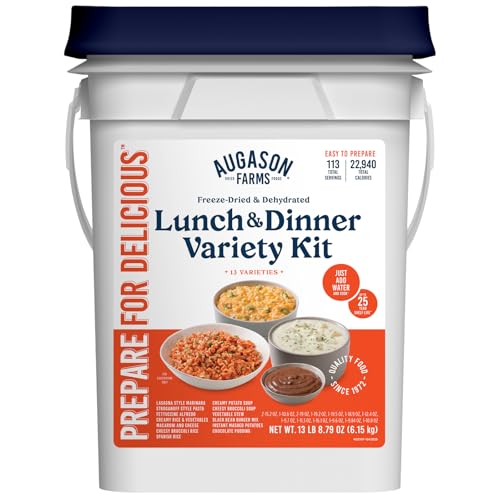
This 113-serving kit from Augason Farms provides a broad variety of meals designed for long-term storage, with a 25-year shelf life. The 4-gallon bucket structure condenses a large amount of food into a portable, organized container, making it suitable for home storage, camping, or disaster kits. The package emphasizes a total calorie count of nearly 23,000 and includes about 22,940 calories across the entrées, enabling diverse meal planning. The meals are prepared by simply adding water and heating on a stove, which is convenient during power outages or outdoor use.
Key considerations: The variety and overall caloric content can support daily meal planning for multiple days. While it offers a robust selection, some users may prefer more single-serving options for individualized meals or dietary restrictions. The reliance on water for preparation is standard for freeze-dried products, but flavor profiles may vary across varieties.
Ready Hour 120 Serving Entree Bucket

Ready Hour offers a 120-serving freeze-dried entree bucket intended for disaster preparedness and outdoor use. The kit emphasizes taste alongside durability, with a storage container described as flood-safe for peace of mind in heavy weather events. The meals are designed to require no refrigeration and can be prepared quickly by adding water. A notable claim is a shelf life of up to 25 years, supporting long-term storage strategies for families or individuals strategizing for extended emergencies.
Key considerations: Ready Hour balances palatability with practicality. The container’s portability and durable design are strong points for outdoor enthusiasts. However, as with most freeze-dried options, long-term flavor consistency and texture can vary between meal varieties, and rotation of stock may be necessary to maintain freshness.
Augason Farms 45 Days Emergency Kit

This 281-serving emergency kit from Augason Farms is designed for a single adult for 45 days or a small group for shorter durations, with a 25-year shelf life. The kit spans 14 meal varieties and aims to provide about 1,218 calories per day and 35 grams of protein, supporting balanced daily intake in an emergency. Just add water and cook as needed, with no advanced cooking equipment required. The emphasis on nutrient density and daily energy aligns with long-term preparedness planning.
Key considerations: The broad variety supports more varied meals, which can help with appetite and adherence during extended storage. The large total calorie count is advantageous for sustained energy, though some users may prefer more compact, individual-serving formats for easier rotation and storage in limited spaces.
ReadyWise 72 Hour Survival Kit

This kit provides 30 servings of protein-rich, freeze-dried meals for a 72-hour emergency window. It’s designed for quick access and portability, making it suitable for go-bags, car kits, or home readiness. The kit emphasizes a shelf life of up to 25 years and a compact form factor that supports easy storage in cabinets, shelves, or vehicle compartments. The focus on protein and calorie content aims to sustain energy during the initial critical days after a crisis.
Key considerations: For short-term emergencies, this kit offers fast meal access and reliable protein density. It is less expansive than multi-week options but excels in portability and quick preparation. Ideal as a supplementary kit to extend existing supplies or as a starter for a small household, especially where space is at a premium.
Buying Guide: Key Purchase Considerations
- Shelf life and storage: Prioritize kits with long shelf life (up to 25 years) and storage-friendly packaging that fits your space constraints, climate, and accessibility needs.
- Serving variety and calories: Look for a mix of meals and a daily calorie target that aligns with household energy requirements. Balance variety with convenience to prevent menu fatigue over time.
- Preparation and equipment: Most kits require only water and a heat source; consider whether you need stove access or prefer no-cook options for portability and speed.
- Portability and container design: Buckets, pouches, and durable containers affect how easily you can transport and store kits in cars, backpacks, or closets.
- Dietary considerations: Check for allergen information, protein types, and presence of vegetarian or low-sodium options if applicable to your household needs.
- Rotation and inventory management: Plan a rotation strategy to ensure you use oldest stock first and replace as needed to maintain freshness.
- Cost and value: Compare total servings, shelf life, and packaging quality to determine long-term value beyond initial price.
- Redundancy vs diversity: Decide whether to buy one large kit or combine several smaller kits to balance redundancy with variety for more resilient preparedness.
In summary, the selected products offer a spectrum of long-term storage options, ranging from large-volume buckets to compact 72-hour kits. Each option emphasizes ease of preparation, durable packaging, and extended shelf life, helping American households build a reliable emergency food reserve tailored to different anticipated scenarios.