Finding a dependable deep cycle battery for camping ensures you have power for lights, small appliances, and charging devices while off-grid. This guide highlights five popular AGM and LiFePO4 options that balance capacity, safety, and maintenance needs for American campers. Each pick is evaluated for roving adventures, RV trips, and backcountry setups, with practical notes on compatibility and longevity.
| Product | Type | Capacity | Approx. Max Discharge Current | Key Benefit |
|---|---|---|---|---|
| Weize Deep Cycle AGM 12V 100Ah | AGM | 100 Ah | 1100 A | Maintenance-free with low self-discharge |
| Renogy Deep Cycle AGM 12V 100Ah | AGM | 100 Ah | 1100 A | Strong safety and versatility for series/parallel config |
| Renogy Deep Cycle AGM 12V 200Ah | AGM | 200 Ah | 2000 A | High capacity for extended trips |
| WEIZE 12V 100Ah Deep Cycle Battery | AGM | 100 Ah | 1150 A | Compact, maintenance-free with spill-proof design |
| Newport 12V 50Ah Deep Cycle AGM | AGM | 50 Ah | Not specified | Lightweight marine compatibility for trolling motors |
Weize 12V 100Ah AGM Battery For Camping
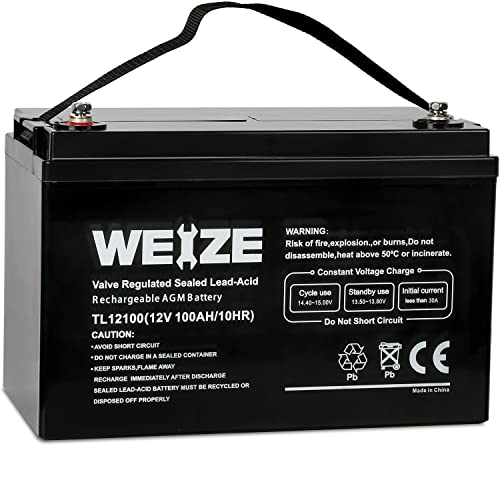
The Weize 12V 100Ah AGM deep cycle battery is designed for maintenance-free use in RVs, solar setups, trolling motors, and off-grid camps. It features an AGM design that minimizes acid leakage and supports a low self-discharge rate, helping storage viability between trips. The unit’s dimensions are 12.99 x 6.73 x 8.43 inches, with a standard left-positive and right-negative terminal layout for easy wiring in compact power systems.
Renogy 12V 100Ah AGM Deep Cycle Battery

Renogy’s 12V 100Ah AGM battery is a trusted choice for RVing, camping, cabins, and off-grid energy storage. It is designed for safe operation with minimal maintenance and supports series and parallel configurations (no practical limit for series, up to four in parallel). Renogy emphasizes safety and stability, offering a dependable solution for long camping weekends and emergency power scenarios.
Renogy 12V 200Ah AGM Deep Cycle Battery

This 200Ah AGM option from Renogy targets campers needing extended power for longer trips or higher energy demands. It uses thick AGM separators and valve-regulated technology to reduce leakage and maintenance. The battery is designed to deliver high discharge currents with low internal resistance, and it benefits from a long shelf life with low self-discharge at typical camping temperatures.
WEIZE 12V 100Ah Deep Cycle Battery

WEIZE’s 12V 100Ah AGM battery offers a compact, maintenance-free design with a spill-proof formula. It’s well-suited for RVs, solar storage, trolling motors, and small off-grid setups. Its 1150A max discharge current supports rapid power availability when needed, while the 1–3% monthly self-discharge helps with seasonal camping cycles when storage is required.
Newport 12V 50Ah Deep Cycle AGM Battery

The Newport Vessels 50Ah AGM battery is a lightweight option ideal for trolling motor use and small marine power needs. Its sealed construction minimizes leaks and makes it a practical choice for compact boat installs or shallow camping setups where weight and space are critical considerations.
Buying Guide: Key Purchase Considerations For Camping Batteries
- Battery Chemistry: AGM batteries are robust, maintenance-free, and handle vibrations well—great for campsites and RVs. Lithium Iron Phosphate (LiFePO4) offers longer life and lighter weight but at a higher initial cost; for small portable camping kits, LiFePO4 options can justify the expense with thousands of cycles.
- Capacity And Runtime: Choose a capacity that matches your expected loads (lights, fans, USB charging, small appliances). Higher Ah translates to longer runtime between charges, but also increases size and weight.
- Discharge Current And Efficiency: A higher maximum discharge current supports quick power delivery for devices that demand bursts of energy. Consider your gear’s startup currents and whether you’ll run devices in parallel.
- Self-Discharge Rate: Lower self-discharge rates improve storage life between camping trips. AGM models typically offer a few percent per month, while LiFePO4 can extend storage viability significantly.
- Maintenance And Safety: AGM and LiFePO4 batteries differ in maintenance needs and safety. AGM is generally spill-proof and low-maintenance; LiFePO4 is safer chemically and more tolerant of deep cycling but may require proper BMS integration.
- Temperature Range: Extreme cold or heat can affect performance. Look for batteries rated for outdoor temperatures that align with your camping season and climate.
- Physical Footprint: Measure available space on your rig, boat, or camping setup. Compact 100Ah AGM units fit many tight compartments, while larger 200Ah packs offer more capacity but require more space.
- Wiring And Accessories: Ensure terminals match your system wiring and that you have appropriate connectors, fuses, and protective enclosures to prevent short circuits or corrosion.
- Warranty and Support: A solid warranty and reputable support can help with long-term ownership, especially for off-grid adventures where reliability matters.